EXPLORER
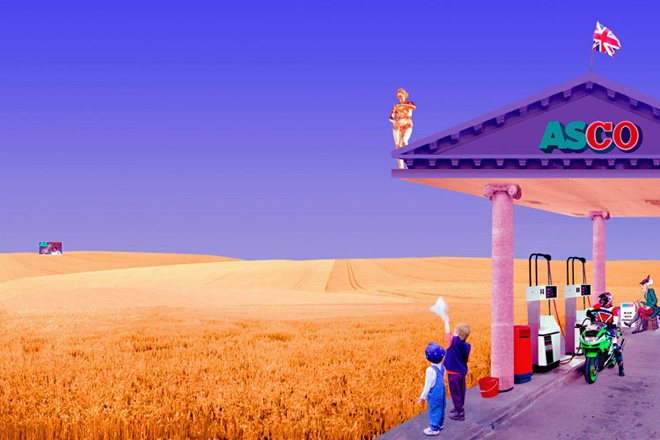
John Goto (1949–2023) was a British artist working with photographic and digital media.
Goto was a storyteller who used narrative forms to explore historical subjects such as the Holocaust (Terezin, 1987), the collapse of the communist states of Eastern Europe in 1989 (The Scar, 1993), the final years of Kazimir Malevich in Stalinist Russia (The Commissar of Space, 1998), iconoclasm during the English Reformation (Loss of Face, 2002), and resistance to British colonialism (Imperium, 2015).
Contemporary events also stimulated his imagination, and at times his indignation, such as the invasion of Iraq (The New World Circus, 2006), the presidency of Donald Trump (Borderline, 2017), Brexit (A Brexit Fantasia, 2019), and the Covid pandemic (Untitled, 2020).
Climate change remained a recurring theme in his work (Thin Air, 2019; Floodscapes, 2007; High Summer, 2001). His love for jazz music and literature also comes to the fore in works such as Django: A Life on the Move (2018) and Kafka in America (2013).
Several series of his work have been exhibited at the gallery as well as at the Musée de l’Immigration at the Porte Dorée.
In his videos, Takehito Koganezawa stages small, proliferating events built through minimalist touches and contemplative poetry. In favor of a filmic graphic design without established frameworks, Koganezawa sometimes monumentalizes his images, he superimposes them or confines them to a reduced and complex surface. Mercury-like water in Water (2005), a ballet of starling flocks in Birds (2006), the improbable swirls of sails in Kite (2006): these familiar scenes develop an unexpected autonomous power and have been exhibited at the gallery.
Music is also an integral part of Koganezawa’s work: repurposing everyday objects and human voices to create random compositions, his works readily combine chance and humour. In Sex without sex (2004), young Japanese students in school uniforms jostle each other in rhythm to a silent composition. As often in Koganezawa’s films, an incongruity gradually emerges, in this case, a rough-and-tumble game in a country where physical contact does not belong to social norms.
Rendered in grainy pastel, his drawings of insects, cars, hybrid animals, and everyday objects are executed in primary colors against a uniformly white background. Devoid of perspective, his childlike figures belong to no context and tell no story. Koganezawa plays with the tension between easy identification and surprise.
Koganezawa’s works are regularly exhibited in Japan and Europe, such as the exhibition “Berlin Tokyo Tokyo Berlin” at the Neue Nationalgalerie (Berlin, 2006). One of his videos was screened at MOCA Los Angeles in May 2007 as part of the exhibition Out of The Ordinary: New Video Art From Japan. Takehito Koganezawa was born in Tokyo in 1974.
He lives and works in Japan after spending a decade in Berlin.
Paul de Guzman is a conceptual artist and video content creator based in Vancouver, Canada. Born in Manila, Philippines, where he studied engineering, Paul de Guzman is self-taught in art. His concept-driven practice is shaped by nomadic gestures and transient objects, characterized by a keen sensitivity to architecture, urbanism, social engagement, and post-colonialism.
Working across a variety of media, such as drawing, text, sculpture, installation, photography, video, performance, and social practice, a significant aspect of his current artistic research examines the role of language, architecture, and colonialism as modes of communication.
He considers language and architecture as mechanisms of social control.
His work has been exhibited in local and international public art institutions such as the Vancouver Art Gallery (Canada), the Musée d’art de Joliette (Canada), the Darling Foundation (Montreal, Canada), the Art Gallery of Windsor (Canada), Oakville Galleries (Canada), Kenderdine Art Gallery (Saskatoon, Canada), apexart (New York, USA), Artspace (Connecticut, USA), Palo Alto Art Center (California, USA), ÉSAD and École du Magasin (Grenoble, France), Fondation Boghossian (Brussels, Belgium), Stichting Duende (Rotterdam, Netherlands), and the Turbine Hall at Tate Modern (London, UK), among others.
His works are part of the permanent public collections of the Canada Council Art Bank, the Vancouver Art Gallery, Simon Fraser University Galleries (Burnaby, Canada), the Kenderdine Art Gallery (Saskatoon, Canada), Hofstra University Museum (New York, USA), Yale University Art Gallery (Connecticut, USA), and several others.
Sue Williamson (born 1941 in Lichfield, UK; lives in Cape Town) emigrated with her family to South Africa in 1948. Trained in printmaking, Williamson works in installation, photography, and video.
She belongs to the pioneering generation of South African artists who began working in the 1970s on the social transformations occurring in apartheid South Africa. In the 1980s, she became internationally recognized for her series of portraits of women involved in the country’s political struggle.
Williamson’s work is held in many public collections, including Tate Modern, the Victoria and Albert Museum in London, the Museum of Modern Art in New York, the Musée National d’Art Moderne at the Centre Pompidou, and the Fonds National d’Art Contemporain (FNAC).
In recent years, her work has been seen in Paris in exhibitions at La Maison Rouge, the Fondation Louis Vuitton, the Monnaie de Paris, the MAC VAL – Musée d’Art Contemporain du Val-de-Marne, and at the gallery since 2020.
A retrospective of her work will open on 20 February 2025 at the Iziko National Gallery in Cape Town.


